Our Latest News from our Blog at: http://hillco-fastener-warehouse.blogspot.com/
Fasteners . . . the last thing you think of, the first thing you need!
A typical situation for a busy professional shop or a do-it-yourselfer is that while you’re in the middle of a repair job or installing a new piece of equipment, you have to stop what you’re doing, get into your car and drive to a hardware store or home improvement center because you need a longer, larger, or different style nut, bolt, or screw. The work on the job or special project comes to a complete stop, and sometimes you don’t get back to it for days, weeks, or months!
The frustration associated with the above scenario can be eliminated with Hillco’s new ProShop Assortments! They are available in a variety of SAE and metric sizes and include nuts, bolts, washers, machine screws, sheet metal screws, studs, and even nylon wire ties, electrical terminals, hose clamps and just about anything you’ll need for installations and repairs.
At a cost of $79.95 each for the heavy-duty plastic drawer and $94.95 for the metal drawer, Pro Shop Assortments are a great value. They are designed to save you time and money, and to eliminate the costly interruptions associated with not having the right fastener on hand. With over 30-years of research and thousands of assortments sold, our Pro Shop Assortments have evolved with experience to make them efficient, practical and economical.
If you’d like more information regarding ProShop Assortments call us at714 657-7442 or send an email to sales@hillcofasteners.com.
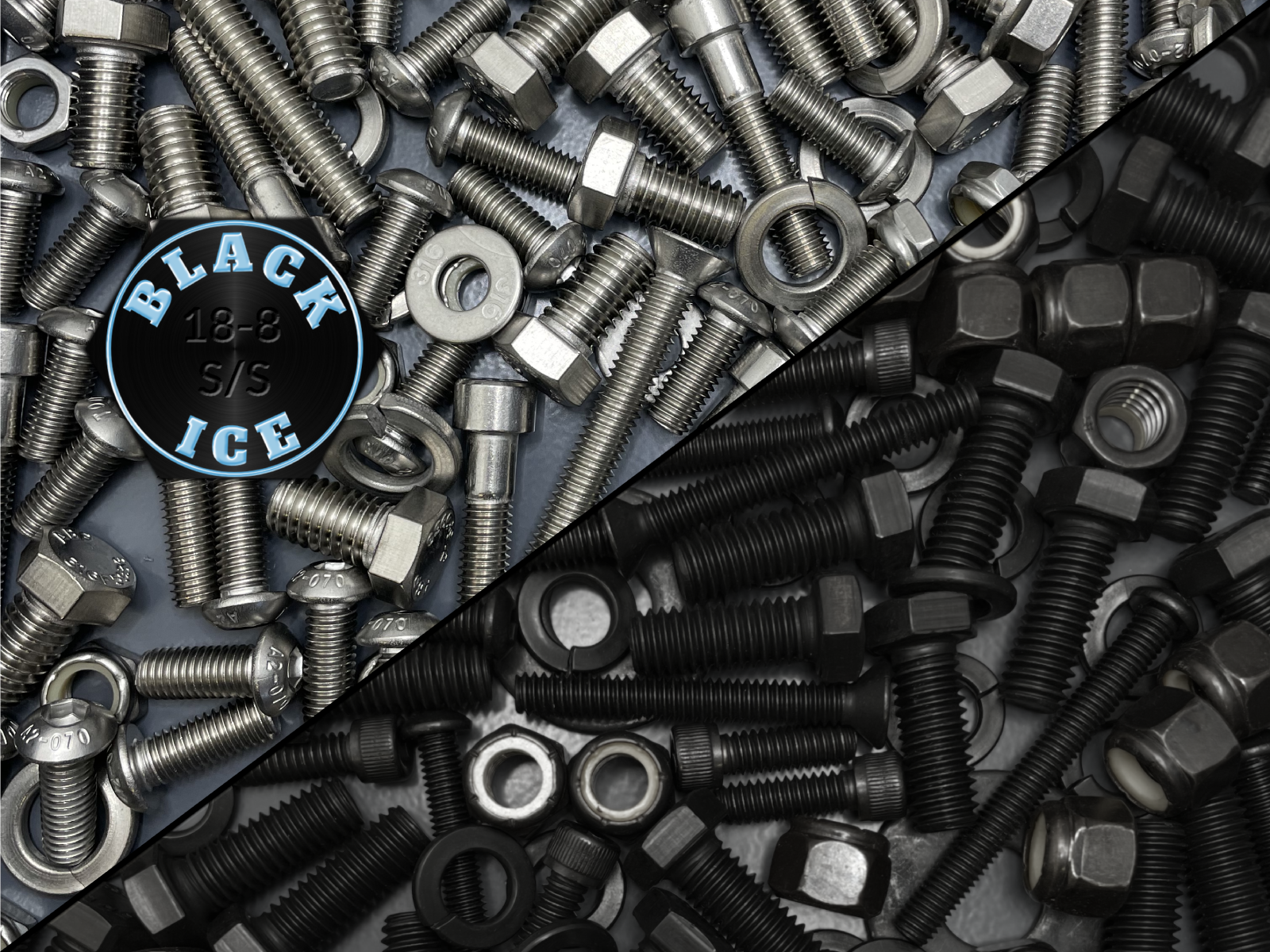
While there are more than one hundred different AISI (American Iron and Steel Institute) chemistry grades of stainless steel, the most commonly used in commercial fasteners (nuts, bolts, washers, fittings) are types 18-8 and 316. "18-8" is short-hand for 18% chromium and 8% nickel. This alloy content is found in types 302,303, and 304 stainless steel. While they offer a high degree of corrosion resistance, they are slightly magnetic. So don't be fooled just because your stainless washers stick to your magnet. Also, there is a small presence of iron in 18-8 fasteners, so they can corrode in severe conditions. 316 stainless generally offers better corrosion resistance and is even referred to as "marine grade stainless," but it is not resistant to warm sea water. Here at Hillco Fastener Warehouse, 99% of all stainless steel fasteners we sell are 18-8, which is sufficient for pretty much all street rod or other automotive projects, in terms of corrosion resistance.
Contrary to popular belief, and probably the most common misconception about fasteners held by our customers here at Hillco, stainless steel fasteners are not very strong. Now, please don't confuse strength with toughness. Anyone who's ever attempted to drill or cut a stainless bolt knows how tough they can be. But for purposes of this article, let's understand that strength refers to tensile strength. A type 18-8 or 316 stainless steel bolt typically has a tensile strength of around 80,000 psi, which is only slightly stronger than a Grade 2 bolt. If I had a nickel for every customer who came to me explaining that he wanted to use stainless steel bolts in place of his stock suspension bolts, I'd be a rich man. But, if I sold them to them, I'd be a poor man due to being sued for selling them weak bolts! There are other types of high strength stainless bolts that are now available for such applications, but they are usually a special order item, as they are too expensive to keep in stock. So, if you need something strong that will not rust, call us and we'll help you find exactly what you need.
Also important to know when using stainless steel fasteners is that they tend to gall, or cold weld. I also wish I had a nickel for every customer that came to Hillco claiming "You sold me the wrong nut. Look, it stuck to the bolt, and I had to break it to get it off!" I then point to the signs posted everywhere recommending the use of anti-seize to prevent galling. This is where I usually hear them say "Ohhhh. So that's what anti-seize is for." We recommend using nickel anti-seize (ND Industries Vibra-Tite part # ND90704, a 4-oz bottle for $9.50). Think of it as cheap insurance for your stainless steel nuts and bolts. You'll spend a lot of time breaking, grinding, and cutting off bolts if you don't use anti-seize.
Our good friend and business associate, John Lazenby of Royze, Inc., recently shared this with us. We thought it was very entertaining and hope you will too!
DRILL PRESS: A tall upright machine useful for suddenly snatching flat
metal bar stock out of your hands so that it smacks you in the chest and
flings your beer across the room, denting the freshly-painted project
which you had carefully set in the corner where nothing could get to it.
WIRE WHEEL: Cleans paint off bolts and then throws them somewhere under
the workbench with the speed of light. Also removes fingerprints and
hard-earned calluses from fingers in about the time it takes you to say,
'Oh sh -- '
ELECTRIC HAND DRILL: Normally used for spinning pop rivets in their
holes until you die of old age.
SKILL SAW: A portable cutting tool used to make studs too short.
PLIERS: Used to round off bolt heads. Sometimes used in the creation of
blood-blisters.
BELT SANDER: An electric sanding tool commonly used to convert minor
touch-up jobs into major refinishing jobs.
HACKSAW: One of a family of cutting tools built on the Ouija board
principle. It transforms human energy into a crooked, unpredictable
motion, and the more you attempt to influence its course, the more
dismal your future becomes.
VISE-GRIPS: Generally used after pliers to completely round off bolt
heads. If nothing else is available, they can also be used to transfer
intense welding heat to the palm of your hand.
OXYACETYLENE TORCH: Used almost entirely for lighting various flammable
objects in your shop on fire. Also handy for igniting the grease inside
the wheel hub out of which you want to remove a bearing race.
TABLE SAW: A large stationary power tool commonly used to launch wood
projectiles for testing wall integrity.
HYDRAULIC FLOOR JACK: Used for lowering an automobile to the ground
after you have installed your new brake shoes, trapping the jack handle
firmly under the bumper.
BAND SAW: A large stationary power saw primarily used by most shops to
cut good aluminum sheet into smaller pieces that more easily fit into
the trash can after you cut on the inside of the line instead of
the outside edge.
TWO-TON ENGINE HOIST: A tool for testing the maximum tensile strength
of everything you forgot to disconnect.
PHILLIPS SCREWDRIVER: Normally used to stab the vacuum seals under
lids or for opening old-style paper-and-tin oil cans and splashing oil
on your shirt; but can also be used, as the name implies, to strip out
Phillips screw heads.
STRAIGHT SCREWDRIVER: A tool for opening paint cans. Sometimes used
to convert common slotted screws into non-removable screws and
butchering your palms.
PRY BAR: A tool used to crumple the metal surrounding that clip or
bracket you needed to remove in order to replace a 50 cent part.
HOSE CUTTER: A tool used to make hoses too short.
HAMMER: Originally employed as a weapon of war, the hammer nowadays
is used as a kind of divining rod to locate the most expensive parts
adjacent the object we are trying to hit.
UTILITY KNIFE: Used to open and slice through the contents of cardboard
cartons delivered to your front door; works particularly well on
contents such as seats, vinyl records, liquids in plastic
bottles, collector magazines, refund checks, and rubber or plastic
parts. Especially useful for slicing work clothes, but only while in
use.
DAMM-IT TOOL: Any handy tool that you grab and throw across the garage
while yelling 'DAMM-IT' at the top of your lungs. It is also, most often,
the next tool that you will need.
"Who buys this stuff?" Hillco employees get that question everday. Odd for someone to be standing in our store, presumably to buy something, or with someone who is looking for some nuts or bolts from our product line, but I digress. While Hillco has enjoyed serving customers large and small in lots of industries, our "bread & butter" has been the auto repair or paint and body/restoration shops. My dad, and Hillco's founder, Jack Hill, has been dutifully calling on and supplying much needed fasteners to shops from San Diego to Los Angeles and the Inland Empire since the early 1970s. He's still at it today, and can't wait for tomorrow. Over the years, he developed a program, called Accu-Pak, which serves as a guarantee to never over-fill the hardware bins or assortments found in most shops. You've seen the gray cabinets (sometimes red, blue, or brown) filled with the various nuts, bolts, fittings, or connectors at your local repair garage. Well, unfortunately, some sales reps have taken advantage of a trusting shop owner by filling those drawers to the brim, regardless of the customer's usage. The guys in the shop just sign for it, the sales rep sends a bill to the A/P department and hopes the owner never even catches on. Most owners do catch on, however, as they watch their dollars just like you and I do. This has the negative effect of causing all shop owners to look down upon fastener salesmen, making cold-calling very tough, and, sometimes uncomfortable. So Hillco guarantees never to do that. This program has served us well over the years. We have a very consistent customer base. In some shops we are now dealing with the second generation, as some owner's children have taken over the family business. As Jack says, "We lose more customers to the cemetery than to the competition." So, if you need a saleman to come by and check your bins, please give Hillco a call. If you don't have any bins, or you need a fastener assortment, Hillco has a great selection of professional shop assortments. We are the most trusted and respected name in automotive fasteners in Southern California, since 1976.
SELF-DRILLING or SELF-TAPPING? What's the difference? If you are confused, don't worry! You are not alone. Confusing self-drilling and self-tapping screws is probably the single most common terminology error we hear at Hillco Fastener Warehouse. A self-drilling screw has a drill-bit point to help drill into metal without pre-drilling holes. They are also called Tek® screws, a brand name, not to be used to refer to generic screws. However, many people who use fasteners in their daily lives, like many of our customers here at Hillco, have come to call self-drillers Teks screws, the way many people refer to all photo copiers as Xerox machines. A self-tapping screw has a sharp point normally and is a type "A" or "AB" tapping screw -- (though there are variations, such as "B" point which are blunt). A self-tapping screw (sheet metal screw, wood screw, lag bolt) cuts its own thread (like a tap), but there must already be a pre-drilled hole. Self-Drilling screws are for metal only and do not work well in wood (except for specially designed parts with reaming wings). Self-tapping screws work well in all materials, but are likely to need a pilot hole in many applications. Hillco sells both self-drillers and self-tappers in steel and stainless steel. We also sell chrome plated trim screws for interiors that come in both variations. Feel free to call us at 714-657-7442 if you'd like to know more!
If you are anything like me (or most of our customers here at Hillco Fastener Warehouse), then measuring fittings can be very confusing. Heck, all fittings are confusing, if we're talking about the size designations and what they are called. For instance, we had a customer trying to complete the plumbing on an off-road project recently. He came into the fitting area with that glazed look in his eyes, so I could tell that I better drop everything and focus. Here's what he said: "I need a 3/8" fitting to come from the oil pump, but the other end to the pan is 1/2" or so. Also, the fuel pump is 3/8" male, which needs to go to the carb, which is A-N. And I need to install an oil temperature gauge, but it has to be male threads. And I would like to use stainless steel braided hoses if I can afford it. How much is this going to cost?" I quickly discovered that the glazed look in his eyes was contagious, because now I had it, too! So, the first thing I did is what I always do when someone comes in looking for brass or Fragola A-N fittings: I grabbed a pencil and a sheet of paper. I have found that, where fittings are concerned, a picture is worth a thousand words. Just basic diagrams work, so that the customer can point out where he needs a male or female fitting, for example. But where it really gets confusing is if the customer doesn't have a sample of the piece they need to replace. Why? Because, there are many different call-outs regarding thread designations. Bolts are easy. If it's American, and if it fits in the 1/2" hole in the gauge (note: if you don't have a Hillco bolt gauge {HI00001-$4.00}, get one! You will find that it will be one of the most-used tools in your tool box), then it's called a 1/2" bolt. Simple! But I have on my desk in front of me a 1/4" NPT pipe plug, a 1/4" A-N union, a 1/4" flare nut, and a 1/4" compression fitting. And guess what? They are all different, and none measures 1/4"! The pipe fitting measures 1/4" on the ID of the fitting, but about 1/2" on the OD. A compression fitting measures 1/4" on the OD of the tube , but the thread pitch of the fitting is 7/16-24. A flare fitting also measures the OD of the tube, but for a 1/4" flare fitting, the thread pitch is 1/2"-20. And, finally, the thread pitch on a 1/4" A'N fitting measures 7/16"-20. Go figure! So please, next time you're looking for a fitting, have some samples. And please, talk slowly!
A 1909 Ford sales brochure noted that Ford moved the Model T steering to the left rather than the standard right hand position for cars of that time period. Their reasoning was that it was safer for passengers exiting on the right (curb side) rather than into the traffic lane due to the number of tractors and other agricultural equipment driving on the streets of many farming communities. Ford also noted that the left hand driving position allowed the driver better visibility and better judgment when passing oncoming vehicles. The popularity of the Model T made left hand steering the norm throughout the United States. (In 2009 the Model T turned 100 years of age!)
I was born in Illinois in 1938, and I’ve always loved automobiles. One of my tricks, to impress girls as a teenager, was to close my eyes and accurately identify any car just by hearing the engine. Automobiles are movement and sound as well as many other things to me. During the 50’s the roar of a flathead Ford or the rat-a-tat of a stovebolt Chevy 6 were music to my ears.
When I came to California, courtesy of the U. S. Marine Corps in 1957, I started attending road racing events. At these events the 283 c.i. Corvette bellowed around the courses at a speed that was in the “Oh My God” category. I was also introduced to the baleful whine of a Porsche twin cam, the rip of the A.C. Bristol and the scream of a Ferrari V12. There were many others too, but I think you get the point.
A few months ago, courtesy of Hillco customer Driftspeed, I attended the Formula Drift Competition at the same venue as the Long Beach Grand Prix. Although I’ve been around as a fan and occasional participant in road racing, I must say the spectacle of drift racing hit me like being dropped into a cage of roaring lions. The sight and sound of these races is an audible feast!
There were all makes and models of autos there – Nissan, Toyota, Mazda, Viper, Corvette, Solstice and many others that I’m sure I haven’t mentioned. Let’s just say that all performance brands were represented very well.
The fabrication work on all of these cars was absolutely top rate. These cars are high tech in every way and, unlike us older guys who thought “Make it bigger, it will go faster,” these builders use sophisticated computerized engine management systems that will make a 3.5 liter Nissan put out a cloud of tire smoke large enough to hide a tank battalion on the attack. With that thought in mind, I began to wonder “What do we call these techno-geniuses squeezing all of this power and sound out of these relatively small motors?” It was then that it hit me! When my computer at home won’t work, who do I call? The Geek Squad! That used to be an offensive name, but today it’s used to describe someone who is intelligent, specifically regarding the use of computers and technology. So it came to me: “Thunder Geeks!” When these “Thunder Geeks” apply their expertise to a Honda, Toyota, or modern Corvette, Viper, or a Pontiac Solstice, for example, the result is ground-pounding, tire burning music to these 70 year old ears. You like sound, drama, power and technology? Don’t miss the next drift event!
A very common problem we face on a regular basis here at Hillco Fastener Warehouse is customers complaining that their bolts "broke." Usually, we hear "You need to replace my bolts. I bought 16 of them and all the heads popped off when I installed them." So, the first thing we have trained our counter men and women to ask is "Ok, I can help you. What kind of bolt was it?" If it's stainless steel, we ask if they used anti-seize. Usually, the answer is no. If that's the case, we then educate them on the need for anti-seize when using stainless steel bolts, sell them some new ones, and off they go, happy to have learned something new. Often times, however, they'll say "I used grade 8 and I barely torqued them at all!" Right...So we pull out a torque-spec sheet (I found a pretty good one here: http://www.raskcycle.com/techtip/webdoc14.html). Usually, they've over-torqued the bolt to the point the head has been stretched right off. It doesn't take much, usually quite a bit less that the customer believes is needed. So get that torque wrench out and follow the specs on your torque sheet, and don't break any more bolts. Now, get back out to the garage and make some noise!